Space Technology Market 2024-2035: Growth Trajectory, Key Drivers, and Strategic Implications of a $682 Billion Industry
Space Technology Market 2024-2035: Growth Trajectory, Key Drivers, and Strategic Implications of a $682 Billion Industry
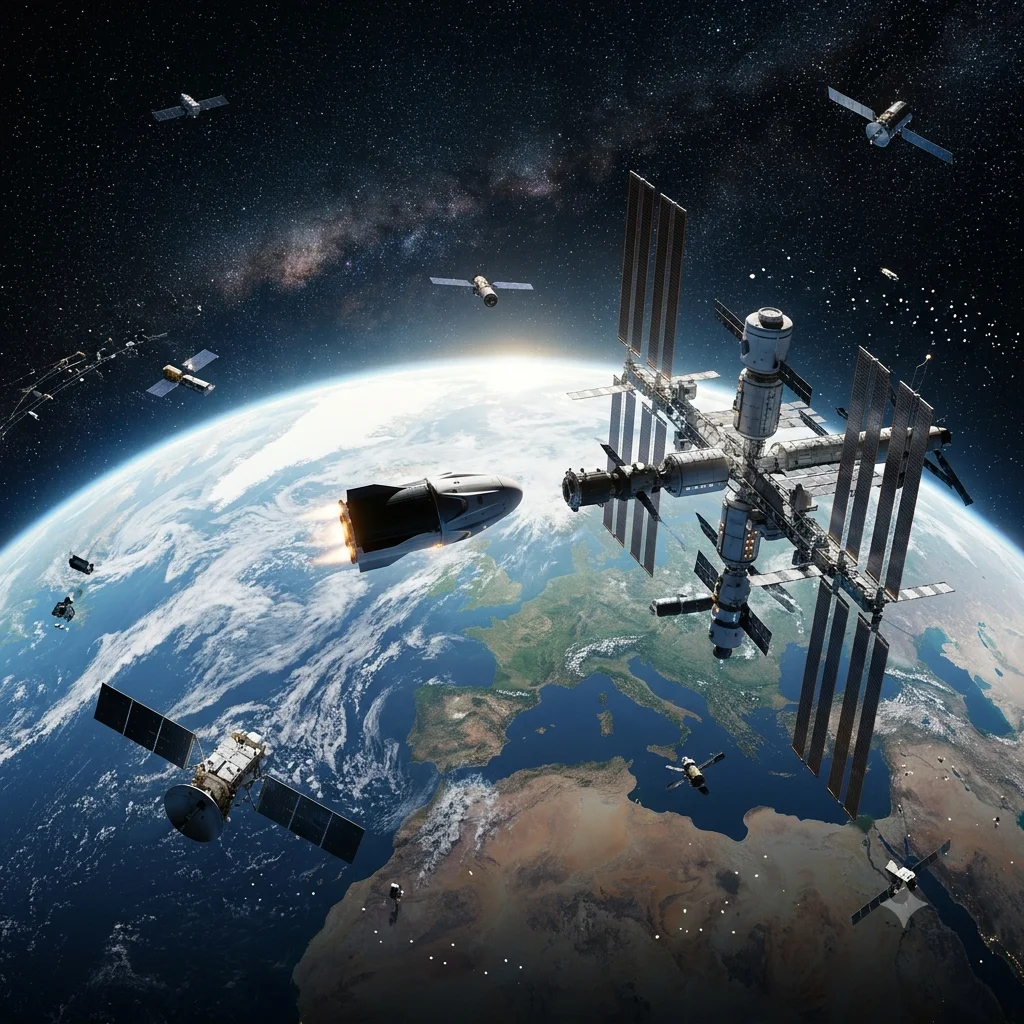
[IMAGE: A futuristic, wide-angle view of Earth from low orbit, with multiple satellites and spacecraft in various orbits, including a sleek reusable rocket approaching a space station. The scene is bathed in soft sunlight with a starfield background. High detail, photorealistic style, cinematic lighting.]
1. Introduction: The Numbers That Define a Decade of Space Commerce
The space technology market is no longer a niche of government agencies—it has become a multi-hundred-billion-dollar industrial pipeline with profound implications for global commerce, security, and innovation. According to current projections, the global space technology market size is expected to grow from $334.49 billion in 2024 to $356.91 billion in 2025, reaching $682.78 billion by 2035 at a compound annual growth rate (CAGR) of 6.7%.
These figures represent more than just a growth trajectory. They signal a fundamental restructuring of how space-based services are conceived, funded, and delivered. The space industry forecast 2035 points to an ecosystem where satellite communications, Earth observation, launch services, and deep-space exploration converge into a tightly integrated commercial infrastructure.
Why does this growth matter beyond the top-line numbers? The implications span national security, where space-based assets have become critical for defense communications and reconnaissance; telecommunications, with low-Earth orbit (LEO) constellations promising global broadband coverage; climate monitoring, where satellite data enables tracking of deforestation, ice melt, and atmospheric changes; and resource extraction, as both government agencies and private enterprises eye lunar water ice and asteroid minerals.
The main drivers behind this expansion are twofold: increased government budgets from agencies such as NASA, the European Space Agency (ESA), and the China National Space Administration (CNSA), and the rising influence of private players including SpaceX, Blue Origin, and Rocket Lab. The interplay between these forces is reshaping the space market CAGR and the strategic calculus of nations and corporations alike.
[IMAGE: Infographic showing a timeline of market size from 2024 to 2035 with CAGR arrow.]
2. The Core Economic Logic: From State Monopoly to Commercial Ecosystem
The space technology market is undergoing a structural transformation that rewrites decades of established economic logic. Traditional government-led research and development is giving way to public-private partnerships and fully commercial ventures, fundamentally altering the industry's value chain.
Consider the evidence: SpaceX's Commercial Crew program has reduced NASA's astronaut transportation costs by approximately 60% compared to the Space Shuttle era. Starlink, SpaceX's satellite internet constellation, now has over 2 million subscribers worldwide, generating revenue that cross-subsidizes launch vehicle development. Blue Origin sells BE-4 rocket engines to United Launch Alliance, demonstrating that even propulsion technology—once the exclusive domain of defense contractors—can be commercialized.
The 6.7% CAGR masks a critical bifurcation within the market. Defense and security spending is growing faster than civil space budgets, driven by concerns over space-based threats and the militarization of orbit. The United States Space Force's budget has grown from $15.4 billion in 2020 to over $30 billion in 2024, a pattern mirrored by other nations. Meanwhile, commercial launch costs are dropping by approximately 40% per decade, driven by reusable rocket technology and manufacturing innovations.
The concentration of power within the industry is notable. The list of major players—SpaceX, NASA, Blue Origin, Lockheed Martin, Boeing, Northrop Grumman, and emerging Chinese firms like LandSpace—reveals an oligopolistic structure where a handful of entities control critical launch capacity, satellite manufacturing, and ground infrastructure. This concentration has implications for pricing, innovation, and market access that investors and policymakers must carefully monitor.
[IMAGE: Diagram comparing government vs. private funding splits in 2024 and projected 2035.]
3. Regional Divergence: North America's Dominance vs. Asia-Pacific's Ascent
The global space technology market displays sharp regional divergences in both current size and growth trajectory. North America currently leads, commanding approximately 45% of global space revenues, driven by NASA's Artemis program, Department of Defense contracts, and SpaceX's vertical integration from launch vehicles to satellite constellations.
Yet the most striking development is the Asia-Pacific region's rapid emergence. Fueled by rising government space investment in China, India, and Japan, Asia-Pacific is registering the highest CAGR among all regions. China's CNSA is pursuing an ambitious lunar base program, with plans for crewed missions and permanent infrastructure by the 2030s. India's ISRO has achieved remarkable cost efficiencies, launching 424 satellites for 36 countries since 1999, and its NewSpace India Ltd is commercializing launch services. Japan's JAXA, combined with startups like Astroscale (orbital debris removal) and ispace (lunar exploration), is building a diversified space ecosystem.
The fastest-growing region is also the most geopolitically complex. Asia-Pacific space growth is intertwined with technology competition, supply chain dependencies, and strategic rivalries. China's Guowang satellite internet constellation—a planned 13,000-satellite network—could fundamentally alter global connectivity and market dynamics, challenging Starlink's dominance. Rare earth elements critical for satellite electronics are predominantly sourced from China, creating vulnerabilities for Western supply chains. Advanced electronics, including radiation-hardened chips, remain a bottleneck for all but a few nations.
This regional competition extends to launch infrastructure. Spaceports are proliferating: India's Satish Dhawan Space Centre, China's Wenchang facility, Australia's Equatorial Launch Australia, and Japan's Tanegashima Space Center are all expanding capacity. The strategic implications are clear—access to space is no longer a luxury but a prerequisite for technological sovereignty.
[IMAGE: World map heatmap with bubble sizes representing space market revenue per region, highlighting North America and Asia-Pacific.]
4. Supply Chain Undercurrents: Fragility and Resilience in the Space Ecosystem
Beneath the headline growth figures, the space supply chain dynamics reveal both fragility and emerging resilience. The industry's dependence on specialized components—radiation-hardened electronics, high-precision optics, lightweight composites, and propulsion-grade metals—creates bottlenecks that can delay missions and inflate costs.
The current supply chain is characterized by several vulnerabilities. First, semiconductor shortages have affected satellite production timelines, with lead times for certain chips extending to 52 weeks or more. Second, the global scarcity of high-grade optical glass has impacted Earth observation satellite manufacturing, as only a handful of suppliers meet the stringent quality requirements. Third, transportation of large rocket components remains logistically challenging, with only a few ports and specialized carriers capable of handling oversized payloads.
However, the industry is adapting. Vertical integration is becoming a dominant strategy: SpaceX manufactures approximately 85% of its Falcon 9 components in-house, from engines to avionics. This approach reduces supply chain exposure and enables rapid iteration. Blue Origin is pursuing a similar model with its New Glenn rocket and BE-4 engine production. On the other hand, a new ecosystem of specialized suppliers is emerging: companies like Additive Manufacturing in Space are developing 3D printing capabilities for orbital use, while others focus on standardized satellite buses that reduce customization needs.
The resilience of supply chains will be tested by geopolitical shocks, trade restrictions, and natural disasters. Companies that diversify their supplier base and invest in redundant production capacity will be better positioned to weather disruptions. The private space enterprises driving much of the current growth are particularly sensitive to these dynamics, as their business models depend on predictable launch cadences and manufacturing throughput.
[IMAGE: Supply chain flow diagram showing components from raw materials to satellite integration, with choke points highlighted.]
5. Dual-Use Technologies: Where Military and Civilian Space Converge
One of the most significant patterns in the contemporary space market is the convergence of military and civilian technologies. Dual-use innovations—technologies with both defense and commercial applications—are blurring the lines between sectors and creating new opportunities and risks.
Satellite Earth observation exemplifies this trend. Commercial operators like Planet Labs and Maxar Technologies provide imagery with resolution sufficient for both agricultural monitoring and military reconnaissance. The same satellites tracking crop yields can identify troop movements or infrastructure changes. This dual-use nature makes space technology market size estimates difficult to parse, as the same asset often serves multiple masters.
Launch vehicles are another arena of convergence. SpaceX's Falcon 9 has launched both NASA scientific payloads and classified National Reconnaissance Office satellites. The company's Starship, designed for Mars colonization, is also under consideration for Department of Defense rapid-response missions. China's Long March rockets serve both civilian and military purposes, with the distinction increasingly academic.
The strategic implication is clear: nations investing in commercial space capabilities are simultaneously building latent military capacity. This dynamic drives government space investment upward, as space programs become instruments of both economic development and national security. The challenge for regulators and arms control advocates lies in managing the proliferation of technologies that could be weaponized, particularly anti-satellite systems and space-based interceptors.
[IMAGE: Split illustration showing the same satellite technology used for agricultural monitoring (left) and defense surveillance (right).]
6. Policy and Regulatory Shifts: The Framework Shaping the Next Decade
The growth of the space technology market is not occurring in a regulatory vacuum. Governments worldwide are updating legal frameworks to accommodate new commercial activities, manage orbital congestion, and address liability concerns.
The United Nations Committee on the Peaceful Uses of Outer Space (COPUOS) continues to debate guidelines for space resource utilization, with the Artemis Accords—signed by 33 nations as of 2024—establishing a framework for lunar cooperation. However, the absence of China and Russia from the Accords creates parallel governance structures that complicate international collaboration.
Orbital debris management has moved to the forefront of regulatory concern. The FCC's adoption of a five-year rule for satellite deorbit—requiring operators to remove spacecraft within five years of mission completion—sets a precedent that other nations are likely to follow. Private space enterprises are responding with debris mitigation technologies: Astroscale's ELSA-M mission demonstrated orbital debris capture capabilities in 2024, while ClearSpace plans to launch its first debris removal mission in 2026.
Spectrum allocation is another regulatory battleground. The proliferation of LEO constellations has created competition for radio frequency slots, with incumbents and newcomers clashing over bandwidth. The International Telecommunication Union (ITU) is under pressure to streamline its filing procedures while ensuring equitable access for developing nations.
Export controls also shape market dynamics. The International Traffic in Arms Regulations (ITAR) in the United States restrict the transfer of space technologies to foreign entities, affecting partnerships and supply chains. Emerging space nations in Asia and the Middle East are responding by developing indigenous capabilities, sometimes with the assistance of countries not bound by ITAR constraints.
[IMAGE: Regulatory timeline showing key space policy milestones from 2020 to 2035.]
7. Innovation Hotspots: What the Next Wave of Technology Will Enable
The space industry forecast 2035 is defined by several innovation hotspots that promise to expand the market's boundaries and create entirely new revenue streams.
In-space manufacturing is transitioning from experimental to operational. Redwire's 3D printing facilities on the International Space Station have produced more than 30 components in microgravity, demonstrating the viability of manufacturing fiber optics and human tissue that cannot be produced under Earth's gravity. By 2030, commercial in-space manufacturing could be a $10 billion market.
Nuclear propulsion for deep-space missions is advancing. NASA and the Defense Advanced Research Projects Agency (DARPA) are developing the Demonstration Rocket for Agile Cislunar Operations (DRACO), a nuclear thermal propulsion system scheduled for testing in 2027. This technology could reduce transit times to Mars from nine months to three months, fundamentally altering the economics of interplanetary travel.
Space-based solar power, once dismissed as science fiction, is receiving renewed attention. The European Space Agency's SOLARIS program and China's planned space power station both aim to demonstrate wireless energy transmission from orbit. While commercial viability remains years away, the potential for baseload clean energy could transform the global energy market.
Autonomous satellite operations are reducing costs and increasing reliability. Artificial intelligence enables satellites to adjust orbits, manage power systems, and process data onboard, reducing the need for ground control intervention. Startups like Orbital Insight and Cognitive Space are developing AI platforms that optimize satellite constellations in real-time, improving efficiency by 30-40%.
[IMAGE: Triptych showing three innovation areas: in-space manufacturing, nuclear propulsion concept, and solar satellite array.]
8. Conclusion: Strategic Implications for Investors, Policymakers, and Technology Strategists
The space technology market's projected growth from $334.49 billion to $682.78 billion by 2035 represents more than a financial opportunity—it signals a structural transformation in how humanity access and utilizes space. For investors, the key insight is that the market is not monolithic. Defense and security segments offer stable, long-term returns, while commercial applications in communications and Earth observation provide higher growth potential but with greater volatility. Diversification across segments and geographies will be essential.
For policymakers, the implications are strategic. Nations that invest in space infrastructure—launch capabilities, satellite manufacturing, and human spaceflight—are positioning themselves for technological leadership in the 21st century. The space technology market size is not just a number on a spreadsheet; it reflects a nation's capacity to project power, protect assets, and participate in the global knowledge economy.
For technology strategists, the challenge is navigating uncertainty. The evolution of launch costs, the maturation of new propulsion systems, and the regulatory landscape will determine which technologies succeed. The companies that thrive will be those that can adapt to shifting supply chains, integrate dual-use technologies, and anticipate the geopolitical currents that shape the industry.
As private enterprises and government agencies push the boundaries of what is possible in space, the next decade will determine whether the market fulfills its promise or succumbs to its challenges. The $682.78 billion forecast is not inevitable—it depends on continued investment, smart regulation, and the resilience to survive setbacks that are inevitable in any frontier industry. Those who understand the forces shaping this market will be best positioned to navigate its complexities and capture its opportunities.
[IMAGE: Final composite image showing Earth from orbit with multiple satellite orbits highlighted, launch trajectories, and futuristic space infrastructure elements.]