R&D Innovation in Food & Beverage: Navigating Post-Pandemic Complexity with the Tree of R&D Model
R&D Innovation in Food & Beverage: Navigating Post-Pandemic Complexity with the Tree of R&D Model
The New Landscape: Market Size and Consumer-Driven Complexity
The global food and beverage industry is undergoing a transformation unlike any other in its history. With revenues reaching approximately $8.67 trillion in 2022 and projected to hit $9.12 trillion by 2024, the sector is on a steady growth trajectory—a compound annual growth rate of 6.47% through 2029. Behind these numbers lies a market that is simultaneously expanding and fragmenting under the weight of evolving consumer expectations.
[IMAGE: Infographic showing year-over-year market revenue growth from 2022 to 2029, with icons representing key consumer drivers such as health, sustainability, and functionality.]
Today’s consumers demand more than just good taste. Health, nutrition, functionality, sustainability, and lifestyle alignment have become non-negotiable criteria. A single product must now check multiple boxes: it should be plant-based or protein-rich, environmentally friendly, ethically sourced, and convenient—all while delivering on flavor. This multiplying complexity creates both opportunity and risk for food companies. The industry employs at least half a billion people worldwide, according to the Food and Agriculture Organization (FAO), underscoring its economic and social significance. Making the right innovation bets has never been more critical.
Post-Pandemic Acceleration: New Rules for R&D Agility
The COVID-19 pandemic served as a brutal stress test for the global food system. Supply chains fractured, consumption patterns shifted overnight, and companies that failed to adapt quickly found themselves lagging behind. As industry analysts have noted, “The pandemic has highlighted the importance of resilience and agility in R&D processes.” This statement captures a fundamental shift: the old model of slow, linear product development is no longer viable.
[IMAGE: Split image: pre-pandemic R&D lab with long development timelines vs. post-pandemic agile lab with rapid prototyping and tasting panels.]
Food companies are now forced to shorten innovation cycles dramatically. Trends such as plant-based meats, functional beverages, and gut-health products emerged or accelerated during the pandemic, and brands that could pivot quickly captured market share. Tasting and lab processes have become more iterative, integrating real-time consumer feedback and digital simulation. Sensory evaluation panels that once took weeks can now be completed in days via virtual tasting platforms. Lab-to-table timelines have compressed from years to months—sometimes weeks—for certain product categories.
This new agility demands organizational changes. Cross-functional teams that include R&D, marketing, supply chain, and regulatory affairs must work in parallel rather than sequentially. Data analytics tools that track consumer sentiment on social media, retail scan data, and online reviews feed directly into product formulation decisions. The post-pandemic R&D lab looks less like a traditional chemistry lab and more like a command center where data, taste, and speed converge.
Introducing the Tree of R&D Model: A Framework for Integrated Innovation
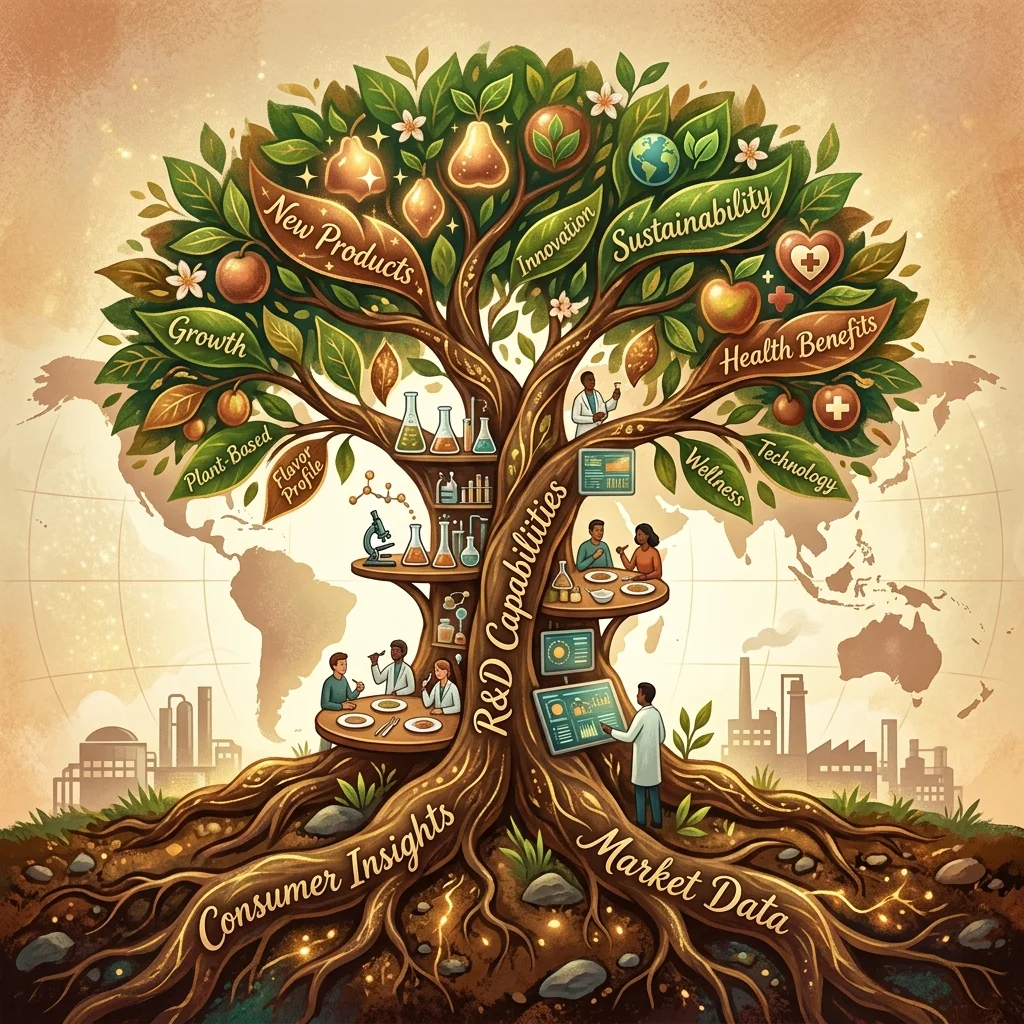
To navigate this complexity, companies need a structured yet flexible framework. The “Tree of R&D” model offers one such approach—a holistic way to unify innovation capabilities, activities, and product innovation into a coherent strategy.
[IMAGE: Diagram of the Tree of R&D model, clearly labeling roots, trunk, branches, and leaves as innovation outcomes.]
In this model, the roots represent foundational market insights and consumer data. These are the inputs that feed the entire innovation process: demographic trends, purchasing behaviors, nutritional gaps, sustainability expectations, and cultural preferences. Without strong roots, the tree cannot sustain growth.
The trunk consists of core R&D capabilities: laboratory equipment and expertise, taste-testing and sensory evaluation infrastructure, digital tools for formulation and simulation, and regulatory compliance knowledge. This is the structural backbone that supports all innovation activities. A robust trunk allows a company to execute across multiple product categories simultaneously.
The branches correspond to specific product categories or innovation streams—beverages, snacks, dairy alternatives, functional foods, etc. Each branch draws on the same trunk and roots but may require specialized resources and market focus.
The leaves and fruits represent tangible innovation outcomes: new product launches, sustainability improvements, enhanced health benefits, and brand extensions. By visualizing the entire system, the Tree of R&D helps firms systematically balance long-term strategic innovation with short-term product launches. It prevents the common pitfall of over-investing in one branch while neglecting root-level consumer insights or trunk-level capability gaps.
Global R&D Investment: A $2.476 Trillion Bet on the Future
The scale of R&D investment in the global food industry underscores the urgency of innovation. In 2022, estimated global R&D spending in food and beverage reached $2.476 trillion—a massive commitment to future growth. This figure spans everything from basic research in food science to applied product development, packaging innovation, and process optimization.
[IMAGE: Bar chart showing global R&D investment in food industry from 2018 to 2022, with breakdown by region (North America, Europe, Asia-Pacific, etc.).]
Yet investment alone is not enough. The real challenge lies in translating that capital into products that meet consumer demands for taste, health, and sustainability. Failure rates for new food products remain high—often above 50% within the first year. Every dollar spent on a product that never reaches the shelf or fails to gain traction is a lost opportunity.
This is where the efficiency of R&D spend becomes critical. Companies must link lab experiments, sensory evaluations, and market data more tightly to reduce failure rates. Digital twins of product formulations, AI-driven flavor prediction, and rapid prototyping with 3D food printing are emerging tools that can accelerate the learning curve. The most effective R&D organizations treat each experiment not as a gamble but as a data point that feeds back into the roots of the Tree of R&D model.
Lab-to-Table Dynamics: Bridging Innovation with Supply Chain Resilience
Innovation does not stop at the lab door. The journey from concept to consumer shelf—often called “lab-to-table”—involves complex interactions with supply chains, manufacturing, distribution, and retail partners. Post-pandemic disruptions have forced companies to rethink this entire pathway.
[IMAGE: Flowchart illustrating the lab-to-table journey: consumer insights → R&D formulation → pilot batch → scaled production → distribution → retail → consumer feedback loop.]
One key insight is that supply chain resilience must be built into product development from the start. A product that requires a rare ingredient sourced from a single region is vulnerable to disruptions. R&D teams are now collaborating with procurement and logistics teams earlier in the development cycle to identify alternative sources, consider local sourcing options, and design formulations that tolerate ingredient variability.
Another dynamic is the rise of direct-to-consumer models and personalized nutrition. Lab-to-table can now bypass traditional retail entirely—some startups develop and ship customized supplements or meal kits based on individual consumer data. This requires R&D capabilities that are modular, agile, and data-integrated.
The strategic implication for food companies is clear: R&D cannot operate in a silo. It must be embedded in a broader ecosystem that includes supply chain, marketing, sales, and sustainability teams. The Tree of R&D model provides a visual language for this integration, reminding leaders that every branch draws on the same roots and trunk.
Emerging Trends and the Road Ahead
As the industry looks toward the remainder of the decade, several trends will shape the next wave of R&D innovation. Cellular agriculture, precision fermentation, and alternative proteins continue to disrupt traditional protein sources. Functional ingredients targeting mental health, immunity, and cognitive performance are gaining traction. Upcycled ingredients—using food waste to create new products—address both sustainability and cost pressures.
[IMAGE: Timeline graphic showing key food innovation milestones from 2020 to 2030, including plant-based boom, precision fermentation approvals, and personalized nutrition expansion.]
At the same time, regulatory landscapes are evolving. Novel food approvals, labeling requirements, and sustainability claims are becoming more stringent. R&D teams must stay ahead of these changes, building compliance into the trunk of their innovation tree from the outset.
The $2.476 trillion R&D investment in 2022 signals that the industry is betting big on science and technology. But the winners will be those who can integrate that investment with deep consumer understanding, agile processes, and resilient supply chains. The Tree of R&D model offers a practical lens for achieving that integration—not as a rigid template, but as a dynamic framework that can adapt to shifting consumer trends and market realities.
In a landscape where complexity is the new normal, the ability to innovate rapidly and effectively is not just a competitive advantage—it is a survival imperative. Food companies that invest in their roots, strengthen their trunks, and nurture their branches will be the ones that bear fruit in the years ahead.