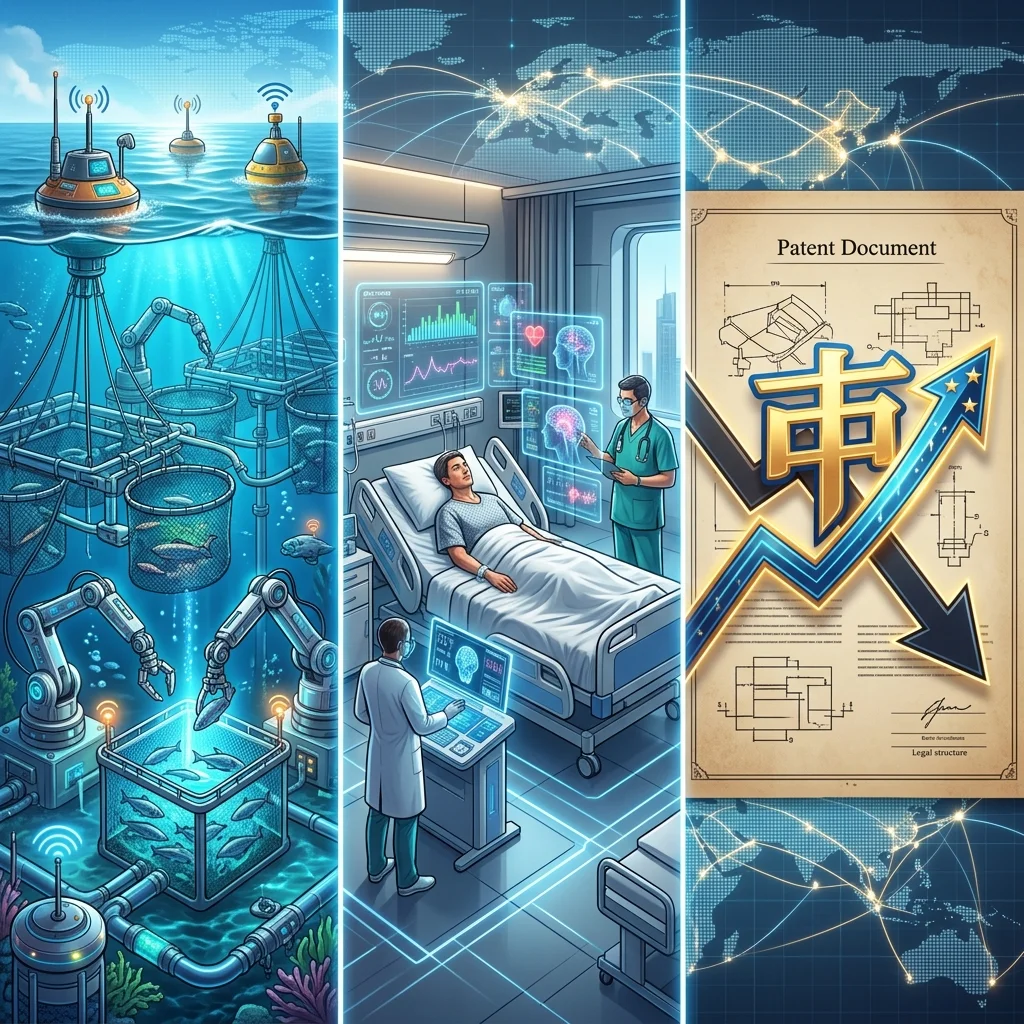
Five Science & Tech Innovation Trends: From AI Healthcare to Blue Economy and IP Shifts
Five Science & Tech Innovation Trends: From AI Healthcare to Blue Economy and IP Shifts
The global innovation landscape is undergoing a structural transformation that few entrepreneurs and investors have fully internalized. Five interconnected trends—spanning ocean-based industries, artificial intelligence in medicine, intellectual property shifts, federal funding vulnerabilities, and agricultural technology convergence—are challenging long-held assumptions about where value is created and how innovation is financed. The data points are stark: maritime commerce demand is projected to triple by 2030, 65% of U.S. hospitals now deploy AI tools, U.S. patent applications have dipped while Chinese trademarks have surged fortyfold, the SBIR/STTR program faced an unprecedented shutdown in 2025, and the boundaries between biology, robotics, and AI are dissolving in agtech. For entrepreneurs and investors, the new imperative is diversification—of capital sources, geographic anchors, and intellectual property strategies.
[IMAGE: World map with highlighted coastal zones and innovation hubs, overlaid with data callouts showing maritime growth rates, AI adoption percentages, and patent filing shifts.]
1. Blue Economy: The Next Frontier for Ocean-Based Entrepreneurship
The blue economy—encompassing fisheries, aquaculture, maritime transport, offshore energy, and ocean data services—has emerged as one of the most capital-efficient and policy-aligned sectors for science- and technology-based entrepreneurship. Global maritime commerce demand is expected to triple by 2030, driven by expanding trade routes, the need for sustainable protein sources, and the push for decarbonized shipping. The economic potential is often underestimated: U.S. coastal counties alone, if measured as an independent economy, would rank third in global GDP, trailing only the entire United States and China. That comparison underscores the untapped value of ocean-adjacent innovation.
The fastest-growing segment within the blue economy is aquaculture technology. The global aquaculture tech market is projected to grow at double-digit rates through 2032, fueled by the convergence of robotics, underwater sensors, and artificial intelligence. Autonomous underwater vehicles now monitor fish health, water quality, and feed efficiency in real time. Robotic arms handle sorting and harvesting, reducing labor costs and mortality. AI-driven predictive models forecast disease outbreaks and optimize feeding schedules, cutting waste by up to 30%. Startups that integrate ocean data analytics—using satellite imagery, IoT buoys, and machine learning—are positioning themselves to dominate the next wave of maritime commerce. The deeper insight: the blue economy rewards companies that can combine hardware durability with software agility, a rare skill set that commands premium valuations.
[IMAGE: Infographic showing ocean zones with autonomous ships, underwater drones, and fish farms, with key metrics on market growth and efficiency gains.]
2. Health and AI Convergence: From Predictive Models to Personalized Care
Artificial intelligence has moved from experimental labs to the hospital floor with startling speed. Roughly 65% of U.S. hospitals now use AI-driven predictive models for risk forecasting, patient monitoring, and treatment recommendations. These tools are not limited to large academic medical centers; community hospitals and rural health systems are adopting cloud-based AI platforms to compensate for staffing shortages. The scope of AI in healthcare continues to expand into diagnostics, where algorithms now match or exceed human radiologists in detecting breast cancer, lung nodules, and retinal diseases. Drug discovery, once a decade-long gamble, is being compressed by generative AI models that screen millions of molecular candidates in weeks.
Yet the real competitive advantage in AI healthcare does not lie in the algorithms themselves. Foundational models are increasingly commoditized. The enduring moat is access to high-quality, diverse clinical data and the ability to achieve interoperability across fragmented electronic health record systems. Hospitals with rich longitudinal datasets—spanning genomics, imaging, and social determinants of health—become irreplaceable partners for AI startups. For entrepreneurs, the opportunity lies not in building a better neural network but in creating specialized tools for underserved niches: rural hospital decision support, mental health triage, and chronic disease management for conditions like diabetes and hypertension. Regulatory and ethical hurdles remain significant, but the direction of travel is clear—AI is becoming a standard tool, not a differentiator.
[IMAGE: Split screen: doctor reviewing AI-generated risk score on tablet next to patient bed with vital signs monitor; second panel shows molecular structures being screened by AI.]
3. Intellectual Property Shifts: Foreign Patents, Trademarks, and the US Innovation Gap
The intellectual property landscape is undergoing a silent but consequential rebalancing. U.S. patent applications dipped in 2022 for the first time in over a decade, while foreign investors now receive 53% of all U.S. patents granted—a milestone that signals a loss of domestic innovation control. The implications are far-reaching: technologies critical to national security, healthcare, and climate resilience are increasingly owned by entities outside the United States. Meanwhile, China’s assigned trademarks have increased more than fortyfold over the past decade, reflecting a strategic shift toward branding and market capture rather than purely technological invention. This pattern suggests that China is building a parallel IP system designed to lock in commercial advantages across consumer goods, software, and industrial equipment.
For U.S.-based science and technology entrepreneurs, the patent and trademark shift creates both risks and opportunities. Startups that rely on a single domestic patent portfolio face heightened exposure to challenges from foreign entities with deeper resources. A more resilient approach involves building a geographically diversified IP strategy—filing in key markets such as the European Union, Japan, and South Korea, while also leveraging trade secrets and data exclusivity for hard-to-reverse-engineer innovations. Additionally, the rise of China’s trademark dominance means that early-stage companies should secure brand protection globally before entering markets where trademark squatting is common. The patent dip also underscores the need to look beyond traditional university tech transfer models and explore open innovation frameworks that can accelerate commercialization without ceding control.
[IMAGE: Chart showing U.S. patent application decline and China trademark growth over 10 years, with a timeline of major policy events. Overlay of globe with patent density heat map.]
4. Federal R&D at a Crossroads: The SBIR/STTR Shutdown and Its Fallout
The reliance of early-stage deep-tech startups on federal funding has been exposed as a critical vulnerability. In 2025, the Small Business Innovation Research (SBIR) and Small Business Technology Transfer (STTR) programs faced an unprecedented shutdown due to a government funding lapse, disrupting hundreds of ongoing projects and delaying new grant cycles for months. For many startups in advanced materials, defense tech, and biomedical devices, these programs are not just a funding source—they are the primary validation mechanism that attracts follow-on venture capital. The shutdown forced companies to scramble for bridge financing, some of which came with punitive terms from investors who exploited the urgency.
The deeper lesson is structural: the U.S. innovation ecosystem has become overconcentrated in federal R&D dollars, which now account for roughly 40% of total domestic basic research funding. Any disruption—whether from political gridlock, budget cuts, or geopolitical tensions—ripples through the entire startup pipeline. Forward-thinking entrepreneurs are already diversifying their capital sources. State-level innovation funds, corporate venture arms, international strategic investors, and revenue-based financing models are gaining traction as alternatives. The shutdown also accelerated interest in public-private partnerships that bypass annual appropriations cycles, such as the Defense Department’s new "innovation authority" initiatives and Department of Energy’s lab-embedded startup programs. The takeaway: federal funding remains a powerful catalyst, but it can no longer be the cornerstone of a resilient funding strategy.
[IMAGE: Timeline graphic showing SBIR/STTR funding cycles and the 2025 shutdown, with callouts to state-level alternatives and corporate VC growth. Photos of startup labs adapting to bridge financing.]
5. Agtech Convergence: Where Biology Meets Robotics and AI
Agricultural technology is undergoing a convergence that defies traditional sector boundaries. Biology, robotics, and artificial intelligence are no longer separate disciplines; they are fusing into integrated systems that can sense, decide, and act in real time across the farm ecosystem. Robotic harvesters equipped with computer vision selectively pick ripe fruit, reducing waste and labor dependence. AI-powered drones map field variability and apply inputs with precision, cutting fertilizer and pesticide use by 50% or more. Synthetic biology firms are engineering microbes that fix nitrogen in the soil, replacing synthetic fertilizers altogether.
What makes this convergence particularly powerful is the data feedback loop. Sensors in the soil, on irrigation lines, and on harvesting equipment generate continuous streams of information. AI models trained on this data can predict yield, disease pressure, and optimal planting schedules with remarkable accuracy. The result is a shift from agriculture as a craft to agriculture as an information science. For entrepreneurs, the entry barrier is lower than ever: open-source robotics platforms, cloud-based AI services, and gene-editing tools like CRISPR have democratized capabilities that once required billion-dollar R&D budgets.
The challenge lies in integration and adoption. Farmers are risk-averse and operate on thin margins. Startups that succeed bundle hardware, software, and agronomic expertise into turnkey solutions that deliver measurable ROI within one growing season. Regulatory frameworks for gene-edited crops and autonomous machinery are still evolving, creating both uncertainty and first-mover advantage. The long-term trajectory, however, is clear: agtech will be one of the largest and most resilient markets for science and technology entrepreneurship over the next decade, driven by climate pressures, supply chain vulnerabilities, and the need to feed a growing global population.
[IMAGE: Infographic showing a farm field with autonomous robots, drones, and soil sensors connected by data flow arrows. Split panel showing gene-editing lab and AI model predicting crop yields.]
Conclusion: The New Rules of Innovation
These five trends—blue economy, AI healthcare, IP shifts, federal funding vulnerability, and agtech convergence—are not isolated phenomena. They are symptoms of a broader rebalancing in how innovation is funded, protected, and deployed. The U.S. can no longer assume that its historical advantages in basic research, patent leadership, and federal support will persist indefinitely. Entrepreneurs and investors who adapt to this new reality will build resilience by diversifying capital sources, rethinking IP strategies across multiple jurisdictions, and targeting emerging sectors like ocean tech and integrated agtech that offer structural growth regardless of political cycles.
The data is clear: maritime demand will triple, AI will become a baseline tool in hospitals, patents will continue to shift eastward, federal funding will remain volatile, and agtech will converge. The question is not whether these changes will happen—they already are. The question is which innovators will position themselves to ride the wave rather than be caught in the undertow.
---
*This article is based on publicly available global economic data, patent office filings, and industry reports as of mid-2025.*